Global buyers need more than a polished product catalogue when selecting Automatic Rising Bollards. They need evidence, operating context, and measurable protection. A busy hotel entrance, for example, may require hundreds of daily cycles, while a logistics gate faces heavier vehicles and mud. The correct choice depends on both threats and routine traffic.
Industry data supports careful evaluation. Grand View Research’s Perimeter Security Market report identifies rising investment in vehicle access control, urban protection, and integrated security systems. MarketsandMarkets also reports continued growth in the physical security market, driven by smart surveillance, access management, and connected infrastructure. These trends matter, but market forecasts vary by region and methodology. They should guide research, not replace engineering judgment.
Security consultant Chris McGoey has said, “Security is not a product; it is a process.” That principle applies directly to bollard selection. Buyers should examine crash-test standards, impact ratings, foundation depth, hydraulic or electromechanical operation, emergency lowering, corrosion resistance, and maintenance access. ASTM F2656 and IWA 14-1 can help compare vehicle-impact performance, although certification details must match the installed configuration. A certified unit may still perform poorly if drainage, power backup, or traffic controls are neglected.
Think beyond the first quotation. Ask for cycle-test records, environmental ratings, spare-parts availability, installation drawings, and documented service response. In cold climates, hydraulic oil and drainage deserve special attention. In coastal areas, stainless steel grade and coating quality become critical. The cheapest option may look efficient. It may not remain so after repeated impact risks, water exposure, and delayed repairs. Real-world selection is less tidy, but that is where dependable protection begins.
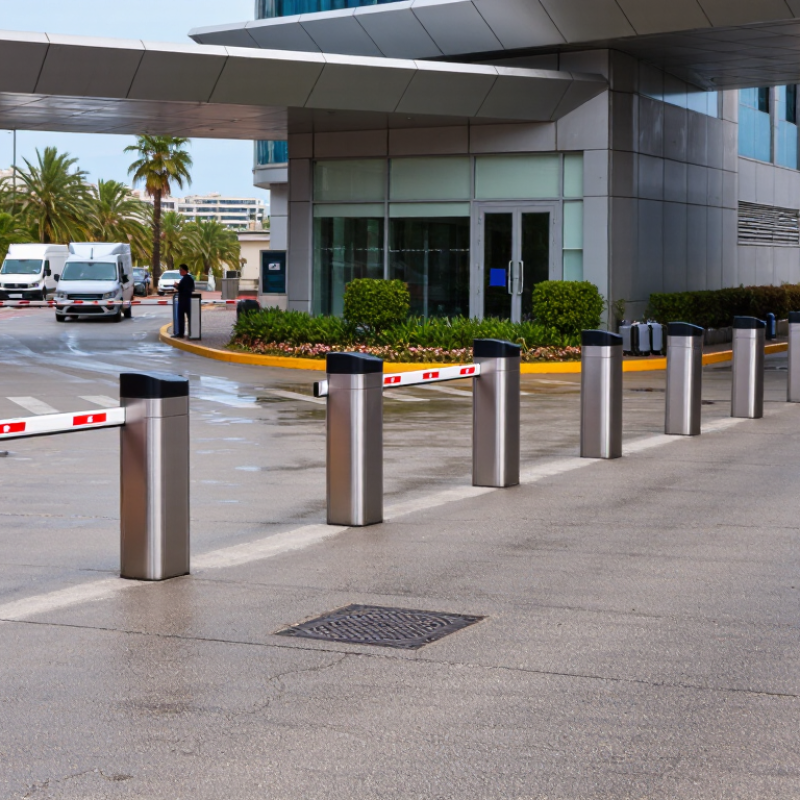
Automatic rising bollards are steel or reinforced posts that move vertically from a hidden foundation. They control vehicle access while keeping pedestrian areas visually open. An electric motor or hydraulic unit lifts the bollard after receiving a signal from a keypad, remote control, access card, or security system. When authorized access is confirmed, the post retracts below ground. Sensors then check its position and help prevent movement when an obstacle is detected. The control cabinet manages timing, safety signals, and emergency operation.
Tips: Check the bollard’s impact rating, lifting speed, duty cycle, and corrosion protection. Confirm the IP rating for the local weather. A backup power option is valuable during outages. Always review drainage and foundation depth before installation. Small site errors can cause expensive repairs.
Global buyers should match the mechanism with actual traffic conditions, not only appearance. Busy entrances may need hydraulic equipment, while lighter access points can use electromechanical systems. A higher speed is not always better. Controlled movement often improves safety and service life. In coastal areas, protective coatings and stainless components deserve closer attention. Also verify operating temperature, replacement parts, wiring requirements, and local safety standards. Installation quality matters greatly; even a strong bollard can perform poorly with weak drainage or incorrect alignment. One detail is often overlooked: emergency lowering should remain practical for trained personnel. This design choice may need rethinking after a real power failure.
| Selection Dimension | Typical Options or Range | How It Works / What It Means | Recommended Use | Buyer Verification Point |
|---|---|---|---|---|
| Basic Definition | Retractable steel security post operated by an electric-hydraulic, pneumatic, or electromechanical mechanism | The bollard rises from a below-ground housing to restrict vehicle access and retracts to permit authorized vehicles to pass | Controlled entrances, pedestrian zones, government sites, commercial premises, and parking facilities | Confirm that the system is a true automatic retractable bollard, not a manually removable or fixed post |
| Security Classification | Standard security, high security, or vehicle-impact-rated | Security level is determined by the post structure, foundation, drive system, crash test evidence, and stopping capability | Use standard units for access control; use impact-rated units where hostile vehicle mitigation is required | Request an independently verified crash-test report where impact resistance is a project requirement |
| Visible Height | Commonly approximately 450–900 mm above ground | The raised section creates a physical barrier. Greater visible height generally improves vehicle obstruction but may affect site appearance and accessibility | Select according to vehicle type, security objective, local streetscape, and required sight lines | Check approved drawings for raised height, retracted depth, foundation depth, and clearance from nearby utilities |
| Post Diameter | Commonly approximately 160–275 mm for access-control models; larger sizes are available for higher security duties | Diameter affects visual presence, structural strength, lane layout, and the size of the required foundation | Use narrower posts where pedestrian circulation and architectural integration are important | Compare outer diameter, wall thickness, material grade, and usable vehicle clearance |
| Operating Speed | Approximately 3–10 seconds for a complete raise or lower cycle, depending on model and safety settings | The actuator moves the post between the raised and retracted positions; speed may vary with temperature, load, and control logic | Fast cycles suit busy entrances; slower controlled movement can reduce impact and improve pedestrian safety | Ask for tested cycle time under the intended voltage, ambient temperature, and duty condition |
| Duty Cycle | Intermittent duty, medium-duty, or high-frequency operation | Duty cycle describes how frequently the bollard can operate without overheating or premature component wear | Medium or high-frequency units are better for logistics entrances, parking facilities, and busy urban access points | Verify cycles per hour, maximum continuous operation, motor protection, and expected daily traffic |
| Drive Mechanism | Hydraulic, electromechanical, or pneumatic | Hydraulic systems use pressurized fluid; electromechanical systems use a motor and transmission; pneumatic systems use compressed air | Hydraulic drives are often selected for demanding applications; electromechanical systems can simplify maintenance; pneumatic systems require suitable air infrastructure | Compare maintenance requirements, noise, emergency lowering behavior, spare parts, and local technical support |
| Power Supply | Common configurations include 110–120 V AC or 220–240 V AC, with low-voltage control circuits | The control cabinet converts and distributes electrical power to the actuator, sensors, and access-control equipment | Choose a configuration compatible with the destination country's electrical supply and site regulations | Confirm rated voltage, frequency, maximum current, earthing requirements, and electrical protection |
| Control Methods | Remote control, RFID or card reader, keypad, intercom, loop detector, ANPR, and building-management interface | An authorized signal is sent to the controller, which checks safety inputs before raising or lowering the bollard | Select one or combine several methods according to user volume, security policy, and integration needs | Check communication protocols, cable distance, encryption, access permissions, and compatibility with existing systems |
| Safety Detection | Inductive ground loop, photoelectric sensor, pressure sensor, obstacle detection, and position limit switches | Sensors detect vehicles, people, obstacles, and post position to help prevent unintended movement or entrapment | Essential for mixed pedestrian and vehicle areas, loading zones, and frequently used entrances | Confirm fail-safe logic, sensor redundancy, emergency stop function, and integration with traffic lights or warning beacons |
| Emergency Operation | Manual release, battery backup, automatic lowering, or standby generator connection | The system moves to a predetermined safe position during power failure, fire alarm, equipment fault, or emergency access | Use automatic lowering where emergency vehicle access and life-safety procedures require an unobstructed route | Define the required safe state and verify backup duration, release procedure, and access for emergency services |
| Material and Finish | Stainless steel, galvanized steel, painted carbon steel, reflective bands, and LED warning illumination | Material and coating protect the post from corrosion, abrasion, de-icing chemicals, and weather exposure | Stainless steel or enhanced corrosion protection is suitable for coastal, humid, or heavily salted environments | Specify material grade, coating system, salt-spray evidence where relevant, reflective marking, and replacement parts |
| Environmental Protection | Outdoor-rated control equipment commonly targets IP55 or higher; underground housings require effective drainage | Ingress protection limits entry of dust and water, while drainage prevents groundwater and rainwater from damaging the mechanism | Use enhanced sealing, heating, or cold-weather kits in regions with heavy rain, snow, ice, dust, or freezing temperatures | Review the complete installed assembly rating, drainage design, frost protection, and operating temperature range |
| Foundation and Drainage | Concrete foundation with a drainage pit, sump, pump, or connection to an approved stormwater system | The below-ground housing must remain stable and dry enough for reliable operation under local soil and weather conditions | Drainage design is especially important in areas with high groundwater, flooding, clay soil, or intense rainfall | Obtain civil drawings, minimum excavation dimensions, concrete requirements, drainage capacity, and maintenance access details |
| Standards and Compliance | Applicable electrical, machinery, electromagnetic compatibility, accessibility, and vehicle-impact standards vary by market | Compliance documentation demonstrates that the equipment has been designed and tested for the intended installation and market | Global buyers should select products whose documentation matches the destination country's regulations | Request declarations, test reports, wiring diagrams, installation manuals, and local approval requirements before purchase |
| Maintenance Requirements | Regular cleaning, drainage inspection, sensor testing, lubrication where specified, and electrical checks | Routine maintenance reduces corrosion, obstruction, water damage, sensor faults, and actuator wear | Important for installations exposed to road salt, dust, sand, frequent rain, or high traffic | Confirm service intervals, technician qualifications, common spare parts, fault codes, and remote troubleshooting options |
| Best-Fit Selection Rule | Match security level, traffic volume, climate, power supply, control method, and emergency policy | A suitable bollard is selected by evaluating the complete site system rather than the post alone | Choose the simplest system that satisfies safety, security, operational, environmental, and regulatory requirements | Request a site-specific layout, technical submittal, total installed cost, lifecycle maintenance plan, and commissioning procedure |
Note: Dimensions, cycle times, ratings, and electrical configurations are typical industry ranges. Final specifications must be confirmed against the selected model, site conditions, applicable local regulations, and the manufacturer's technical documentation.
Request an independent impact-test certificate. It should state vehicle mass, impact speed, penetration distance, and tested configuration. Confirm the certificate covers foundations, controls, and warning lights. Attractive specifications are not enough.
No. Different testing systems use different methods and classifications. Confirm which requirements local authorities and insurers recognize. Ask for measurable evidence, not only sales language.
It should detect vehicles and pedestrians using loops, photocells, or pressure sensors. The bollard should stop or reverse when an obstacle appears. Audible warnings should operate during movement. Emergency lowering and manual release are important.
Ask how the system fails safely after power loss. Useful features include battery backup and authorized manual operation. Test emergency lowering before opening the site. Assumptions can fail during storms.
Check soil strength, drainage, traffic speed, available power, and local engineering rules. Review chamber depth, reinforcement, cable routes, and water protection. Measure twice. A standard power supply may not suit every location.
Water, grit, and poor drainage can damage equipment quickly. Verify drainage capacity and maintenance access before installation. Coastal sites also need tested corrosion resistance. Stainless-looking surfaces are not proof of durability.
Request duty-cycle data, inspection intervals, fault records, and replacement times. Ask about pumps, seals, lights, and control boards. Keep critical spare parts nearby. A “low maintenance” claim needs evidence.
Check technician training, response times, time-zone coverage, and remote diagnostic capability. Ask who handles a motor failure during heavy rain. Require written warranty duties and service responsibilities. This detail is often underestimated.
Include civil works, commissioning, training, spare parts, transport, and local service. A low purchase price can hide difficult logistics. Compare full ownership costs, not just equipment prices. Recheck assumptions with a local engineer.
Automatic Rising Bollards are retractable security posts designed to control vehicle access while preserving pedestrian movement and site appearance. They operate through an electric, hydraulic, or pneumatic mechanism that raises or lowers the bollard according to authorized commands, traffic schedules, or access-control systems. Global buyers should first define their security and traffic-control needs, including threat level, vehicle frequency, opening speed, traffic volume, and emergency access requirements. These factors help determine the suitable bollard type, dimensions, impact resistance, operating cycle, and installation arrangement.
When comparing options, buyers should review materials, corrosion resistance, visibility, drainage, power supply, and performance in local weather conditions. Important verification points include structural testing, electrical safety, fail-safe operation, obstacle detection, manual release, warning signals, and compatibility with access-control equipment. Installation planning should cover foundation depth, drainage, cabling, traffic diversion, and local site conditions. Buyers should also assess maintenance procedures, spare-part availability, warranty terms, technical support, delivery capability, and supplier experience to ensure reliable long-term operation across different regions.

 KAVASS