As cities grow, a Street Furniture Bench is more than a place to sit. It can shape how residents pause, meet, and move through public spaces. UN DESA’s World Urbanization Prospects: The 2018 Revision estimated that 55% of the world’s population lived in urban areas, with that share projected to reach 68% by 2050. More urban residents make durable, comfortable street furniture an increasingly practical investment.
Yet a bench that works in one climate may fail in another. Coastal salt, intense sun, freezing winters, and frequent cleaning all affect material choice and service life. The World Health Organization’s Global Age-friendly Cities: A Guide highlights outdoor seating and places to rest as useful features of age-friendly public environments. That guidance makes comfort and access worth considering alongside price, capacity, and appearance.
Small details matter. Seat height, armrests, drainage, anchoring, and repair access can change daily usability. For global buyers, supplier specifications should be checked against the actual installation site, not just a catalogue image. Look for clear material descriptions, finish details, warranty terms, and evidence of relevant testing. A low purchase price can be tempting; it does not tell the whole story. This guide presents 10 Street Furniture Bench buying tips to help buyers compare options carefully, while recognizing that no single design suits every street, budget, or community.
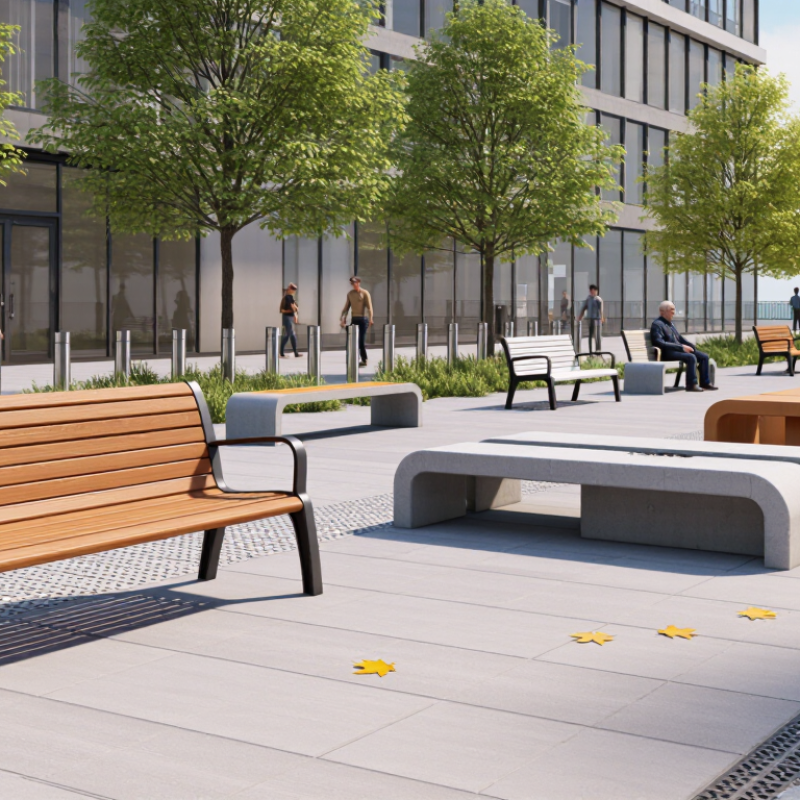
Street furniture benches serve different public needs. A backrest bench supports longer pauses in parks and civic squares. Armrests can help older visitors sit down and rise. Armless, modular seats allow flexible layouts near busy walkways. Perch rails suit brief waits where space is tight, while picnic benches support shared meals. Comfort is contextual.
The World Health Organization’s Global Age-friendly Cities guide highlights accessible seating as part of age-friendly public space. UN DESA’s World Population Prospects 2022 projects that one in six people worldwide will be over 65 by 2050, compared with one in eleven in 2019. For buyers, that shift makes back support, armrests, and clear access worth considering. A seat placed in shade, near a path, can be more useful than an elaborate design in full sun.
Transit stops need durable seats that leave room for circulation and mobility devices. Plazas benefit from movable or clustered seating, while parks often need benches with backs and nearby resting points. Check drainage, surface temperature, cleaning access, and replacement parts before choosing materials. A catalogue specification can look convincing, yet miss local habits. People may prefer facing a path, not a planting bed. The site tells the story.
Place benches where people naturally pause: beside transit stops, shaded paths, clinic entrances, and playground edges. UN-Habitat’s World Cities Report 2022 estimates that 56% of people lived in urban areas in 2021, rising to 68% by 2050. That growth makes flexible, well-sited seating increasingly useful. Check drainage, maintenance access, evening lighting, and pedestrian flow before fixing a location.
Tip: Map sun and shade at different times. Count users during peak periods, then consider whether several smaller benches serve the site better than one long unit.
Climate matters, too. In hot or wet sites, test material samples for heat retention, corrosion, and slip risk. A catalogue photo cannot show how a dark seat feels at noon.
Set capacity from observed use, not guesswork. Allow space for mobility devices and keep accessible routes clear. The U.S. Access Board’s accessibility standards specify bench seat heights of 17–19 inches and depths of 20–24 inches; treat these as a reference, not a universal rule, and check local requirements. Include back support where people may wait longer. Still, a technically compliant drawing can miss awkward transfers or blocked sightlines. Review a full-scale layout on site before ordering.
Compare benches by exposure, not appearance alone. Powder-coated steel is rigid and often economical, but a deep scratch can expose rust-prone metal. Aluminum resists rust and is lighter, though thin sections may flex under concentrated loads. Stainless steel suits damp sites, but alloy grade and finish matter near salt spray. Timber feels warm under hand; repeated wetting and drying can loosen joints. The USDA Forest Products Laboratory’s Wood Handbook details how moisture changes affect wood. No material is maintenance-free.
Construction decides whether those materials last. Look for sealed or well-finished welds, rounded edges, drainage holes, and replaceable fasteners. Water trapped inside a hollow leg can cause trouble even when the outer surface looks sound. NACE’s 2016 IMPACT study estimated annual corrosion costs at $2.5 trillion, or 3.4% of global GDP. It estimated established corrosion-control practices could reduce those costs by 15–35%. These are economy-wide figures, not bench-specific predictions, but they show why coatings and upkeep deserve attention. Salt wins slowly.
Tip: Match the finish to the site: coastal air needs stronger corrosion protection than a sheltered courtyard. Ask suppliers for coating thickness, material grade, and relevant weathering-test results. Check whether replacement slats and fasteners are available. One detail is easy to miss: a durable seat can still fail early if its fixings trap water or loosen under repeated use.
Indicative outdoor service-life ranges by material (years). Actual performance depends on climate, construction quality, installation, and maintenance.
Compare the full bench, not just its material: check frame joints, drainage, fasteners, protective finishes, and replacement-part availability. Coastal salt, standing water, UV exposure, and poor maintenance can shorten service life; confirm local project requirements with the supplier.
Tip 1: Check safety before comparing finishes. Ask for tested load capacity, anchoring details, and corrosion-resistance information. Inspect welds, edges, and gaps where fingers or clothing could catch. A bench beside a busy path may need different clearances from one in a quiet courtyard. Confirm applicable local standards and accessibility requirements; they vary by market.
Tip 2: Treat maintenance as part of the purchase. Look for replaceable boards, accessible fasteners, and coatings that suit the site’s climate. Salt air, frequent rain, and strong sunlight can shorten service life. Ask how often surfaces need cleaning or refinishing, and whether routine repairs require specialist tools. Small details matter. Still, a product sheet cannot predict every site condition, so plan an on-site inspection.
Tip 3: Compare lifecycle costs, not just the quoted price. Include delivery, installation, cleaning, replacement parts, and likely repairs over the expected service period. A lower-cost bench may need more frequent attention; a higher initial price does not guarantee better value. Request a clear warranty scope and parts availability in writing. Then compare those figures with the actual use and maintenance capacity of the site.
| No. | Buying tip | What to check | Standards and evidence | Maintenance and lifecycle planning |
|---|---|---|---|---|
| 1 | Match the bench to its location | Confirm whether it will be installed in a coastal, urban, park, transit, or high-traffic setting. Record exposure to salt, standing water, de-icing chemicals, vandalism, and intense sunlight before choosing materials and finishes. | Ask for material and coating specifications, test reports, and documented limitations for the intended environment. A test method alone does not guarantee a particular service life. | Use local exposure conditions to set inspection frequency and replacement assumptions; coastal or heavily used sites may need more frequent checks. |
| 2 | Check structural safety and stability | Review the frame, joints, edges, fasteners, and load-bearing parts. Check for sharp edges, pinch points, loose components, tipping risk, and damage that could expose users to injury. | Request applicable load or mechanical test documentation. EN 581-1 and EN 581-2 may be relevant to outdoor seating, but confirm their scope and suitability for the specific public-space bench and local requirements. | Plan routine checks for movement, cracked welds, corrosion, and missing or loosened fasteners. Record findings and repairs by asset location. |
| 3 | Verify accessibility and usable space | Check seat height, approach space, clear walking routes, armrests, and nearby wheelchair or mobility-device parking space against the project’s accessibility brief. | Apply the accessibility laws and public-realm design guidance for the installation jurisdiction. Requirements vary by country, city, site type, and project; do not rely on a single global dimension. | Check that the chosen layout remains accessible after installation, including when nearby bins, trees, signs, or seasonal equipment are present. |
| 4 | Select materials for durability | Compare metal, timber, recycled polymer, and composite options for strength, weathering, repairability, surface temperature, and availability of replacement parts. | For fabricated steel, ask whether hot-dip galvanizing is specified to a relevant standard such as ISO 1461. For painted systems, request the coating system and the project’s corrosion-protection specification; suitability depends on exposure and preparation. | Compare expected cleaning, refinishing, and component-replacement needs rather than purchase price alone. Confirm that replacement parts will remain available. |
| 5 | Review anchoring and foundations | Confirm surface-mounted or embedded installation, anchor type, substrate requirements, drainage, and access for future removal. Have the fixing design checked for the site’s substrate and anticipated loads. | Request installation drawings, fixing details, and substrate assumptions. Local building, public-space, and product-safety requirements take precedence where applicable. | Include installation labor, foundation work, traffic management, and future anchor access in the budget. Inspect anchors periodically for movement, corrosion, or tampering. |
| 6 | Assess comfort and weather performance | Review seat depth, back support, armrest options, drainage, and surface finish. Consider direct-sun exposure, rainwater retention, and whether the bench will be comfortable in the local climate. | Request drawings, finish samples, and a physical sample or prototype when comfort, color, or surface feel is important. Confirm any project-specific ergonomic criteria. | Favor designs that drain and dry readily. Include periodic checks for splinters, peeling finishes, rough edges, and water-trapping joints. |
| 7 | Plan for cleaning and repair | Check whether surfaces are easy to clean and whether boards, slats, armrests, or fixings can be replaced individually. Ask which cleaners and repair methods are compatible with the finish. | Request a written care guide, spare-part list, and repair instructions. Confirm that replacement components can be ordered without replacing the complete bench. | Set a site-specific schedule for cleaning and inspection. Frequency depends on foot traffic, pollution, weather, and vandalism; use trial maintenance records to refine the schedule. |
| 8 | Compare lifecycle costs | Compare purchase, shipping, installation, cleaning, inspection, repairs, replacement parts, removal, and end-of-life costs over the same evaluation period. | Use a consistent cost model and document assumptions for service life, labor rates, inflation, and discounting. A lower initial price does not necessarily mean a lower total cost. | A simple comparison is: total cost over the chosen period = purchase + installation + planned maintenance + repairs + removal − residual value, if any. |
| 9 | Check warranties and service support | Read warranty coverage for structure, finishes, and components. Check exclusions for installation, coastal exposure, misuse, vandalism, and routine wear, as well as claim procedures and response times. | Request written warranty terms, installation instructions, product documentation, and confirmation of spare-part availability in the destination market. | Budget for costs not covered by warranty, including inspection, labor, transport, and damage from external causes. Keep purchase and maintenance records for claims. |
| 10 | Consider sustainability and end of life | Ask for material composition, recycled-content documentation where claimed, repair options, and guidance for separating materials at end of life. | Request verifiable environmental documentation and check that claims match the product configuration being purchased. Consider project or public-procurement rules in the destination country. | Prefer durable, repairable designs with locally available parts and a practical route for reuse or recycling. Include removal and disposal costs in lifecycle estimates. |
Note: Standards, accessibility rules, and maintenance requirements vary by jurisdiction and installation context. Confirm current local requirements and product applicability before purchase.
A reliable supplier should explain how each bench is made, not just send a polished catalog. Ask for drawings, material grades, finish details, and recent production photos. For outdoor steel, clarify the coating process and how cut edges are protected. For timber, request the species, treatment method, and maintenance guidance. Small details matter. A vague answer about “weather resistance” is not enough. Ask for references from projects in a similar climate, then check whether the benches have held up through a full season.
Certification claims need careful review. Request copies of test reports and confirm which product model, material, or process each document covers. Standards differ by destination, so check requirements with the project’s local specifier or authority. A certificate for one component may not cover the assembled bench. This is easy to overlook. I would also keep a written record of approved samples, colors, and dimensions; otherwise, a neat quotation can still leave room for costly assumptions.
Shipping plans deserve the same attention as product quality. Confirm packing dimensions, delivery terms, lead times, and who handles import paperwork before placing an order. Ask for photos of packaging, especially protection around feet and finished edges. For installation, provide site measurements and confirm anchor positions, foundation needs, and access for lifting equipment. A simple installation drawing helps, though it may not capture every uneven paving stone. Allow time for a site check before drilling.
Place them near transit stops, shaded paths, clinic entrances, and playground edges. Check pedestrian flow, drainage, lighting, and maintenance access.
Count users during busy periods instead of guessing. Leave room for mobility devices and keep accessible routes clear. One long bench may not suit every site.
A U.S. accessibility reference lists seat heights of 17–19 inches and depths of 20–24 inches. Local requirements may differ, so check them. Try a full-scale layout on site.
Ask for tested load capacity and anchoring details. Inspect welds, sharp edges, and gaps that could catch fingers or clothing. Small details matter.
Test samples for heat, corrosion, and slipping in local conditions. Salt air, rain, and strong sunlight can shorten service life. A catalog photo tells you little about midday heat.
Ask how often surfaces need cleaning or refinishing. Check whether boards and fasteners are replaceable, and whether repairs need special tools. I might still overlook a site-specific issue.
Include delivery, installation, cleaning, parts, and likely repairs. Request written warranty details and parts availability. A low quoted price may mean more upkeep.
Request drawings, material details, finish information, and recent production photos. Check test reports against the exact model and components. Keep approved samples, colors, and dimensions in writing.
Confirm packing dimensions, delivery terms, lead times, and who handles paperwork. Share site measurements and check anchor positions, foundations, and lifting access. Check it on site.
Choosing the right Street Furniture Bench begins with understanding where and how it will be used. Consider whether the bench is intended for parks, sidewalks, transit areas, or other public spaces, then assess the site’s dimensions, expected visitor capacity, local climate, and accessibility needs. These factors help determine an appropriate design, seating layout, and level of durability.
Compare materials and construction methods for comfort, weather resistance, and long-term upkeep. Before purchasing, review relevant safety requirements, maintenance needs, and total lifecycle costs rather than focusing only on the initial price. Also evaluate suppliers based on product information, available certifications, shipping arrangements, and installation support. A careful comparison of these considerations can help buyers select practical, durable seating that suits the location and remains easier to manage over time.

KAVASS